Showing posts with label Taiwanese tea. Show all posts

Thursday, February 6, 2014

Fushoushan (Lishan) High-Mountain Oolong • 福壽山 (驪山) 高山烏龍

Photo & Video Sharing by SmugMug

When I first began learning about Taiwan's high-mountain oolongs at Kkikdageo, it revolved around Lishan (梨山, Pear Mountain) in the central region of Taiwan. So, I was a little confused when I went in one day to replenish my stash and was asked, "Why do you want Lishan oolong? Why not try something different?" The something different was an amazing organic, medium roasted oolong from Taiwan that knocked my socks off, but I still longed for that sweet, floral, light oolong from Lishan that I'd grown to love.

Several times after, I asked if there was any Li-shan oolong in but I was always referred to something else, different types of Ali-shan oolong, usually. I wondered if maybe the market for Li-shan had pushed the price beyond what it was worth, as I'd seen happen with Bilochun. One part-time worker told me that the tea gardens were resting for a few years, but she hadn't been a reliable source for information in previous conversations, so I wasn't sure if it was actually the case, though it sounded reasonable. After that, I just decided to stop asking.

Last week, I dropped by and Prof. Ahn served some incredible high-mountain oolong. It was slightly reminiscent of Tie Guanyin but was certainly Taiwanese. Assuming it wasn't from Li-shan, I asked if it was Ali-shan cha. He explained that it was from Boksu-san, the highest tea garden in Taiwan at 2500 meters. I thought it would be a good time to ask about Li-shan and why they stopped selling Li-shan tea, which lead to a bit of a confusing exchange, until finally, he concluded, "This is Li-shan tea!"

With a pen and paper, he drew a sketch of Li-shan with it's highest peak being Boksu-san, the Korean pronunciation for Fushou-shan (福壽山, which translates roughly as "Blessed Life Mountain, but has the connotations of a life of happiness, luck, and longevity. Anyway, an all-around great name for a tea-producing mountain!). In his opinion, Fushoushan cha is the best high-mountain tea in Taiwan, and I have no trouble believing him.

Though most of our conversation revolved around why my Korean isn't better than it is after all these years, we did get some tea-talk in too. He told me, "After ten steeps, when oolong loses its taste, leave it for a 30 minute steep and it will taste good. Next, an hour and then leave it steeping over night and drink it in the morning." Of course, you should add some hot water after a long steep to really make it better.

I never did get to the bottom of why they went so long without supplying Lishan cha, but I'm excited that it's back and, really, that's all that matters!

Tuesday, October 1, 2013

Dong Feng Mi Ren (Oriental Beauty) • 東方美人

Photo & Video Sharing by SmugMug
Dong Feng Mi Ren (Oriental Beauty) • 東方美人
also commonly named Bai Hao Cha (White Hair Tea) • 白毫茶

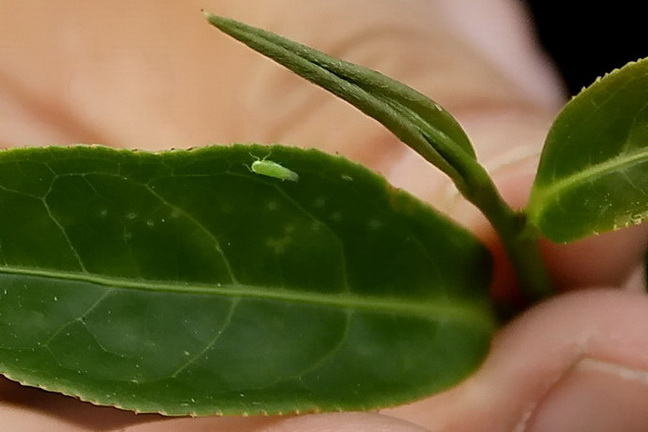
Of all the teas I've explored, Oriental Beauty is among the most intriguing, most unique, and all-around most wonderful. Its story is one of serendipity, stubborn determination, and a tiny green cricket.

It all started in Taiwan during the late 1800's with tea farmers who'd recently immigrated from China, bringing tea plants with them. During the early months of summer, when temperatures began to soar, many of the new tea gardens would be ravaged by swarms of tea jassids, a tiny cricket-like creature that sought shelter from the heat in the shade of the dense tea bushes, feeding on the young leaves and buds.

The early tea Taiwanese farmers received prices based on the quality of their tea from the merchants, among them John Dodd, a Scottish merchant who was a central figure in exporting Taiwanese tea to the West. They didn't even bother harvesting leaves from the crops that had been desecrated by the tea jassids, since they figured they would most likely be unable to even sell it at all. Then, one unorthodox farmer, determined to salvage something of his summer crop, harvested his fly-bitten leaves and set off to present his tea to John Dodd. When he returned, his neighbours couldn't believe the price he bragged to have claimed for his tea but he wasn't lying.

It wasn't long before it was in high demand in the west and it is said that when Queen Victoria was presented with it, she was so enchanted with its beauty that she, herself, dubbed it Oriental Beauty. Others dispute this, saying that Oriental Beauty was in fact created in 1920, after the time of Queen Victoria and that it was actually Queen Elizabeth II who named it in the 1960's. It's likely legend that any queen named the tea at all, but according to sources that I trust, it did originate before the turn of the 20th Century. As far as its name, maybe someone should ask Queen Elizabeth II before it's too late!

In response to the tea jassid's bite, the leaves produce an antibody that in turn imparts an incredibly sweet fragrance and flavour to the tea. The insects also prompts the oxidation process and when the entire process is finished the leaves are left with a beautiful range of rich tones; white, green, orange, burgundy, and dark brown.

I was taught to steep Oriental Beauty at a very low temperature, only 70°C (158°F). It doesn't require a huge amount of leaves either, about a third of the pot is enough. Though I usually stick with Yixing pots, I sometimes use ceramic for Oriental Beauty, since it delivers the full flavor of this tea. There's no need for the porousness of Yixing clay to take away anything. For this post, I couldn't help but use a Xishi pot, designed, in a sense, after the legendary "most beautiful girl in China" but more on that in another post...

Oriental Beauty is potent enough to deliver an exceptional taste with a relatively small amount of leaf. It's a deeply oxidized tea, about 70%, medium roasted, and made entirely of buds and small leaves. A high-quality Oriental Beauty has a warm, honey fragrance and even a rose water quality I haven't encountered in any other tea. When brewed strongly, it can release a nearly red color, but a light golden brew seems to express this tea's best qualities.

Examining the finished leaves, you can find leaves with little dark specks on them, where the tea jassid fed. The bitten leaves turn a more yellowish tint (on the bush) and become misshapen and slightly crumpled. A high concentration of spotted leaves means a very high quality tea. The leaves should be small, as well. The more tips and small leaves, the better.

Of course, there are many imitations now, even coming from mainland China. It doesn't mean they're all bad but the best Oriental Beauty still comes from the town of its origin, in Hsinchu County.

Photo & Video Sharing by SmugMug


Photo & Video Sharing by SmugMug

Photo & Video Sharing by SmugMug

Photo & Video Sharing by SmugMug

Photo & Video Sharing by SmugMug


Photo & Video Sharing by SmugMug